NYT Sudoku: How to Play and Beginner-Friendly Solving Techniques
Not every NYT puzzle needs a dictionary — NYT Sudoku is pure number logic, and it’s one of the most played puzzles on the platform. If Wordle is about vocabulary and Strands is about spotting hidden words, Sudoku is about disciplined, step-by-step deduction across a 9×9 grid.
What Is NYT Sudoku?
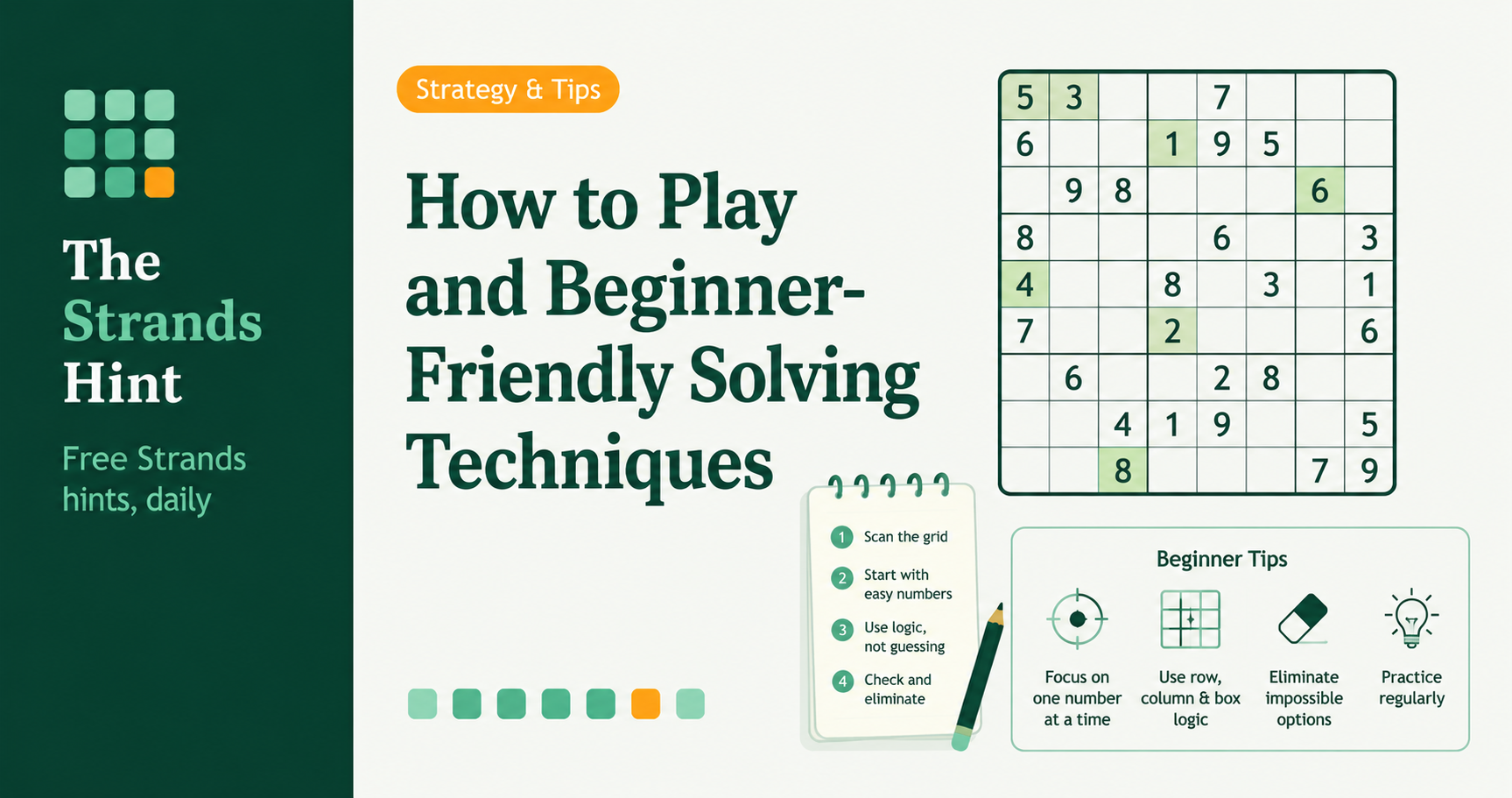
Sudoku is a 9×9 grid split into nine 3×3 boxes. The goal is to fill every empty cell so that each row, each column, and each 3×3 box contains the digits 1 through 9 exactly once, with no repeats anywhere. Some cells are already filled in as ‘givens’ and can’t be changed. NYT publishes a new set of Easy, Medium, and Hard puzzles every day, similar to how a fresh Mini Crossword drops daily.
How to Play
- Each row must contain the digits 1-9 with no repetition
- Each column must contain the digits 1-9 with no repetition
- Each 3×3 box must contain the digits 1-9 with no repetition
- A properly built Sudoku has exactly one valid solution and never requires blind guessing
- NYT offers a Candidate Mode for jotting down possible numbers in a cell before committing to one
Core Solving Techniques
Naked Singles
Scan for a cell that only has one possible number left once you account for its row, column, and box. This is the simplest and most common move you’ll make in any puzzle.
Hidden Singles
Sometimes a cell could technically fit more than one number, but a specific digit can only go in that one cell within its row, column, or box. Spotting these takes a bit more scanning, but they unlock puzzles that naked singles alone can’t finish.
Naked Pairs and Triples
When two or three cells in the same unit share the exact same two or three candidate numbers, those numbers can be eliminated from every other cell in that unit. This technique becomes essential once you move from Easy into Medium and Hard difficulty.
Using Candidate Mode Effectively
Turning on Candidate Mode lets you pencil in every number a cell could possibly hold, the same patient, systematic approach that helps when working through a tricky Letter Boxed chain. On Hard puzzles especially, fully marking candidates before hunting for patterns saves you from missing an elimination hiding in plain sight.
Common Mistakes to Avoid
- Guessing when stuck instead of looking for the logical move you’ve missed
- Skipping candidate notes on Hard puzzles and relying on memory alone
- Only scanning rows and columns while forgetting to check the 3×3 box
- Moving on from naked singles too quickly, before the grid is fully scanned
Quick FAQ
Do I need a subscription to play NYT Sudoku?
No, the daily Sudoku puzzle is free to play, in the same way Spelling Bee is free to play.
Is there more than one difficulty level each day?
Yes, NYT publishes Easy, Medium, and Hard Sudoku puzzles daily, each requiring progressively more advanced techniques.
Can a Sudoku puzzle have more than one solution?
No, a properly constructed Sudoku always has exactly one valid solution, which is what makes pure logic enough to solve it.
Final Thoughts
NYT Sudoku rewards methodical scanning over speed. Start with naked singles, build up to hidden singles and pairs, and lean on Candidate Mode for the harder grids — the puzzle will open up faster than it looks at first glance.