NYT Strands vs NYT Connections: Which Daily Word Puzzle Should You Play?
If you only have time for one NYT word puzzle today, which one should it be? Strands and Connections both test vocabulary and pattern recognition, but they reward very different kinds of thinking — and knowing the difference helps you pick the right puzzle for the mood you’re in.
NYT Strands: Hidden Words in a Letter Grid
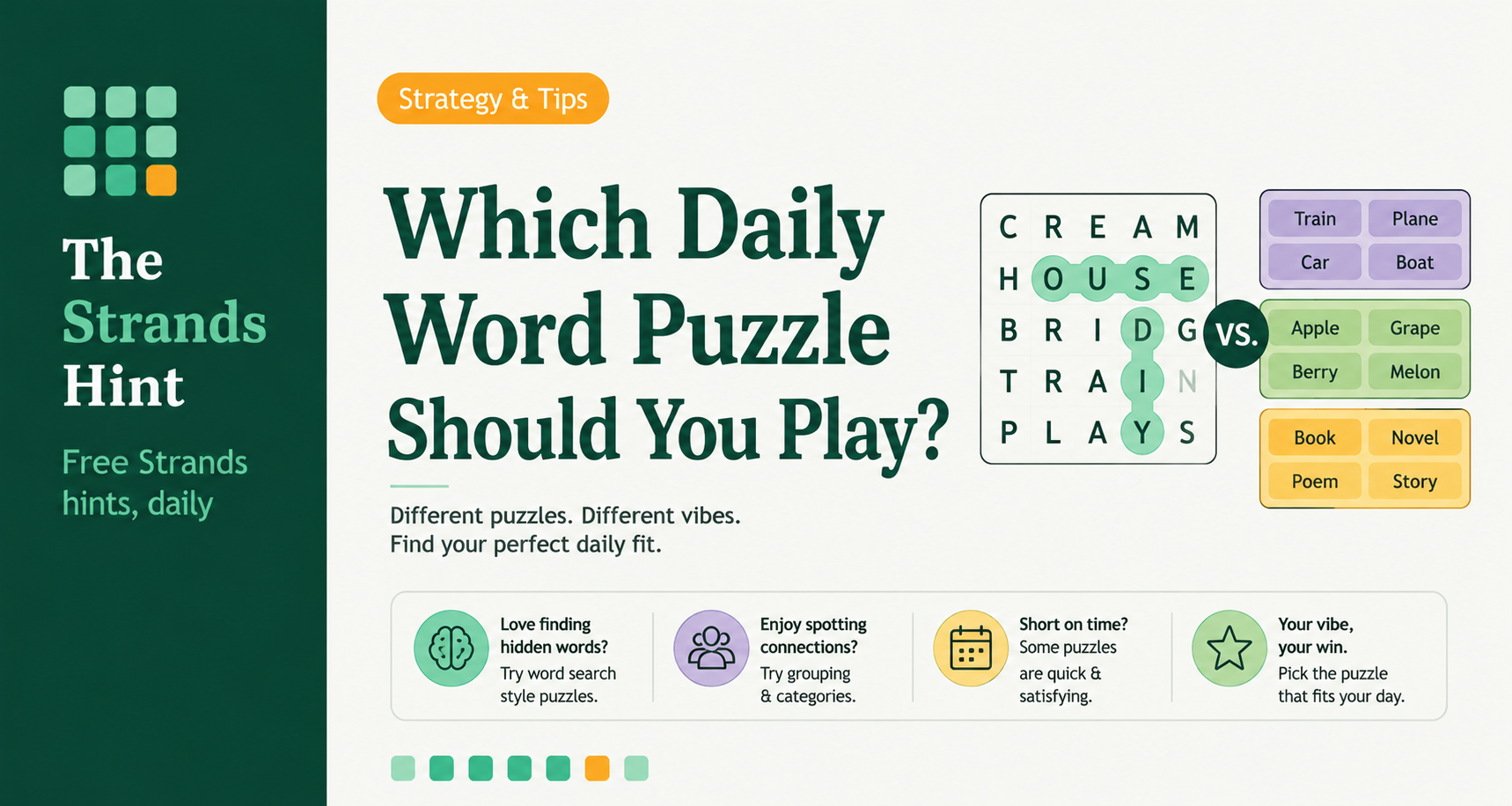
Strands hands you a grid of letters and a daily theme, and your job is to trace out hidden theme words by connecting adjacent letters. One special word, the spangram, touches two opposite sides of the board and sums up the day’s theme. If you ever land on this page looking for a Strands hint, it’s usually because the theme is worded cleverly enough that the connection isn’t obvious until a few other words are already found. That’s by design — Strands rewards patient exploration over quick guessing.
NYT Connections: Grouping by Hidden Category
Connections gives you 16 words and asks you to sort them into four hidden groups of four, each tied together by a shared category. The twist is that the puzzle deliberately includes overlapping red herrings, so a word that looks like it belongs in one group often actually belongs in another.
Key Differences
- Format: Strands is a letter-tracing search; Connections is a word-sorting grid
- Difficulty curve: Strands tends to ease you in with a few findable words before the theme clicks; Connections often front-loads its trickiest red herrings
- Daily theme: Strands always centers on a single wordplay theme with a spangram; Connections uses four separate categories with no single unifying idea
- Time to solve: Strands generally takes a little longer since you’re scanning a full letter grid; Connections can be quicker once you spot two or three solid groups
Which One Should You Play First?
Play Strands If You Want a Slower, Thematic Puzzle
Strands is the better pick when you have a few extra minutes and enjoy the satisfaction of a theme slowly revealing itself as you find more words.
Play Connections If You Want Something Quicker and Sharper
Connections suits a faster session, especially if you enjoy spotting sneaky categorization and second-guessing which group a word actually belongs to.
Or Just Play Both
Since both puzzles are free and reset daily, most regular solvers end up playing both — Connections for a quick warm-up, then Strands for a slower theme-hunting session, or vice versa depending on the day.
Common Mistakes in Each Puzzle
- In Strands, ignoring the theme title and searching randomly instead of using it as a clue
- In Connections, locking in a guess too early without checking if a word fits a different category better
- In both, giving up right before the pattern would have clicked with one more look
Quick FAQ
Are Strands and Connections made by the same team?
Yes, both are part of the NYT Games daily puzzle lineup, alongside Wordle, Sudoku, and others.
Is a new Strands hint needed every day?
Many solvers look for a Strands hint on trickier theme days, especially when the spangram doesn’t reveal itself quickly — that’s normal, not a sign you’re missing something obvious.
Which puzzle is better for beginners?
Connections is often easier to start with since the 16 words are visible upfront, while Strands takes a little longer to get a feel for how the theme and spangram work together.
Final Thoughts
Neither puzzle is strictly better — Strands rewards patient theme-hunting, while Connections rewards sharp, fast categorization. If you’re stuck on today’s board and searching for a Strands hint, take a step back and re-read the theme title; it’s almost always the fastest way back on track.