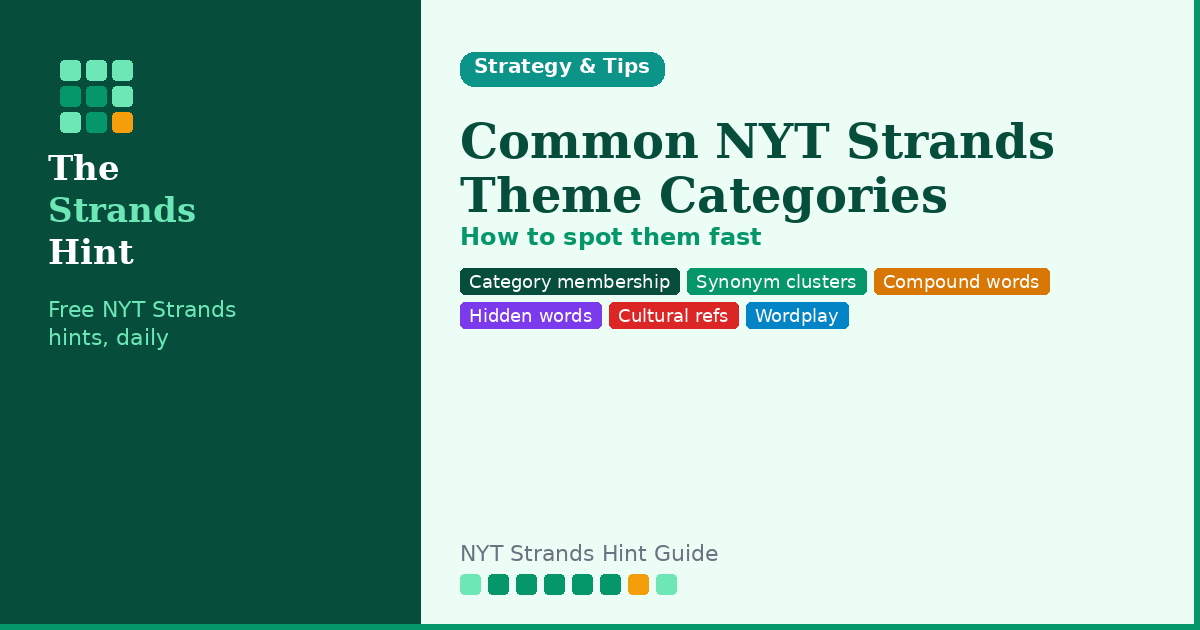
Common NYT Strands Theme Categories — How to Spot Them
One of the fastest ways to improve at NYT Strands — The New York Times Games’ free daily word puzzle — is to build a mental library of the theme categories the puzzle uses most often. The New York Times Games editorial team draws from a finite set of category types, and once you recognise them, your decoding speed improves dramatically. This guide covers every major category type, the hint phrases that signal them, and the word lists you should generate for each.
| About this guide:Based on analysis of hundreds of NYT Strands puzzles since the game’s 2024 launch. Category frequency estimates are approximate and based on observed patterns across the full archive. |
| Quick answer:The most common NYT Strands theme categories are: category membership (things that belong to a named group), synonym clusters (words that mean the same thing), compound word themes (words sharing a common element), hidden word themes (words containing a smaller word), and cultural reference themes (words connected to a film, song, or event). Recognising which type you’re dealing with is the first step to fast solving. |
Why Theme Categories Matter
As covered in our guide to what the Strands hint means, the theme hint is your primary clue — but the hint only becomes useful once you’ve identified the type of theme you’re dealing with. A synonym cluster theme requires a different mental approach than a hidden word theme. A cultural reference theme requires different knowledge than a category membership theme. Knowing the type first tells you which tool to reach for.
Category Type 1 — Category Membership (~40% of puzzles)
What it is: All theme words belong to a clearly defined category — types of X, examples of Y, things associated with Z.
| Common examples:Soft materials: VELVET, FLEECE, SATIN, COTTON, CASHMERE (‘What a softie’)Songbirds: NIGHTINGALE, CANARY, LARK, WARBLER, THRUSH (‘What a trill’)Earth and soil types: SOIL, CLAY, LOAM, TERRAIN, CRUST (‘Who on earth’)Shades of pink: BLUSH, MAGENTA, FUCHSIA, CARNATION, CERISE (‘Am I blushing’) |
How to spot it: The hint phrase points at a category noun — a material, a living thing, a place, a colour. Ask: what type of thing is this hint describing?
Word list strategy: Once you identify the category, exhaust it. List every member you know — don’t stop at 5. Common sub-categories: fabrics, animals, colours, foods, sports, countries, instruments, professions.
Spangram pattern: Usually a phrase that names or describes the category itself. SOFT TOUCH for soft materials, BIRD SONG for songbirds.
Category Type 2 — Synonym Clusters (~20% of puzzles)
What it is: All theme words are synonyms or near-synonyms — words that share a core meaning but with different shades of connotation, formality, or usage.
| Common examples:Words meaning to continue: CARRY ON, PERSIST, PROCEED, EXTEND, RESUME (‘Do go on’)Ways of walking: STROLL, STRIDE, AMBLE, TRUDGE, SAUNTER (‘Were walking’)Words meaning talent: SKILL, GIFT, APTITUDE, FLAIR, KNACK, FACULTY (‘What talent’)Words meaning respect: HONOUR, ESTEEM, REVERE, ADMIRE, DEFER, VENERATE (‘A little respect’) |
How to spot it: The hint phrase uses a verb or describes an action or quality rather than a category of objects. ‘Do go on’, ‘Were walking’, ‘What talent’ — these describe states or actions, not things.
Word list strategy: Think across formality registers — formal (VENERATE, APTITUDE), everyday (ADMIRE, SKILL), and idiomatic (DEFER, KNACK). Strands synonym clusters always span at least two registers.
Spangram pattern: Usually the most common or idiomatic expression of the core concept. KEEP GOING for continuation, GIFTED FEW for talent.
Category Type 3 — Compound Word / Shared Element (~15% of puzzles)
What it is: All theme words are compound words or phrases that share a common element — a hidden word, prefix, or suffix that connects them all.
| Common examples:Words containing a colour: BLACKBIRD, GREENHOUSE, BLUEPRINT, REDWOODWords starting with FIRE: FIREWORK, FIREPLACE, FIREFIGHTER, FIRETRUCKWords ending in STONE: CORNERSTONE, LIMESTONE, COBBLESTONE, MILESTONEWords containing an animal: CATFISH, DOGTAG, HORSEPLAY, FOXHOUND |
How to spot it: The hint often references the hidden element explicitly or cleverly. ‘Seeing red’ might point to words containing RED. ‘What a character’ might point to words containing a letter name.
Word list strategy: Once you identify the shared element, generate words that contain it: think compound nouns first (most common), then compound verbs and adjectives. Don’t forget two-word phrases — FIRE TRUCK counts as much as FIREWORK.
Spangram pattern: Often contains the shared element itself, or is a phrase that describes the connection. If the theme is ‘words containing STONE’, the spangram might be STEPPING STONE or STONE COLD.
Category Type 4 — Hidden Word (~10% of puzzles)
What it is: All theme words contain a smaller hidden word embedded within them — a colour, number, animal, musical note, or other category word concealed inside a larger word.
| Common examples:Words hiding a number: thREE, fOURteen, fIVEr, SIXth, seVENthWords hiding a colour: bROWNie, gREENhouse, bLUEbell, gOLDenWords hiding an animal: mEWS, cATnap, fOXy, hORSEpowerWords hiding a musical note: reDO, miFAce, sOLar, LAme |
How to spot it: The hint usually references the hidden category directly or as a pun. ‘What a note!’ might mean words containing musical notes (DO, RE, MI, FA, SOL, LA, TI). ‘Seeing red’ might mean words containing the word RED.
Word list strategy: This is the hardest type to list words for in advance — you need to search the grid letter by letter, looking for the hidden element in any orientation. Focus on 5–8 letter words where the hidden element is most likely to appear.
Spangram pattern: Usually a phrase that describes the hidden word category — or itself contains the hidden element prominently.
Category Type 5 — Cultural Reference (~10% of puzzles)
What it is: All theme words relate to a specific cultural moment — a film, TV show, song, book, historical event, or public figure. The connection requires cultural knowledge rather than general vocabulary.
| Common examples:Characters from a specific TV showSongs by a particular artistFilms in a franchiseHistorical figures from a specific era or fieldWords associated with a current season, holiday, or cultural event |
How to spot it: The hint is often a famous quote, song lyric, film title, or a phrase strongly associated with a specific cultural property. If you recognise it as coming from somewhere specific, that’s the signal.
Word list strategy: Generate as many elements of the referenced property as you can — character names, song titles, associated words. Cultural reference themes reward breadth of knowledge over vocabulary depth.
Spangram pattern: Often the name of the property itself, or the most iconic phrase associated with it.
Category Type 6 — Idiom / Wordplay (~5% of puzzles)
What it is: The theme connects words through a wordplay mechanism — puns, double meanings, or words that can follow or precede a specific word to make a new phrase.
| Common examples:Words that can follow ‘high’: HIGH ROAD, HIGH TIDE, HIGH RISE, HIGH FIVEWords that can precede ‘ball’: FOOTBALL, BASEBALL, PINBALL, FIREBALLWords that are homophones of other words: PEAR/PAIR, FLOUR/FLOWERWords that are anagrams of each other |
How to spot it: The hint phrase involves wordplay itself — a pun, a double meaning, or explicit reference to a language game. ‘What a trill’ (trill/thrill) is a pun. This category requires the most creative interpretation.
Word list strategy: Once you identify the wordplay mechanism, generate words that fit it systematically. For ‘words that follow HIGH’, list compound words and phrases methodically.
Quick Reference — Category Identification Table
| Hint type → most likely category:Hint describes a quality or feeling → Synonym cluster or category membershipHint is a pun or wordplay → Wordplay/idiom theme or hidden word themeHint is a famous quote or cultural phrase → Cultural reference themeHint uses a verb in progressive form (‘Were walking’) → Synonym clusterHint is an exclamation about a thing (‘What a softie’) → Category membershipHint references a specific noun (earth, trill, respect) → Focus on that noun’s category |
For the full history of how these category types have appeared across all published puzzles, see our complete NYT Strands themes archive. For how difficulty varies by category type, see our guide to why Strands is harder on some days.
Building Your Personal Category Library
The fastest path to improvement in NYT Strands is building a personal mental library of theme categories. Every puzzle you solve adds a new entry. Every puzzle where you needed hints — even if you checked the answers — teaches you a new category to recognise faster next time.
Keep a simple note on your phone: after each puzzle, write down the category type and three words you didn’t immediately think of. After 30 puzzles, you’ll have a personal category library that makes future puzzles measurably faster. For the full systematic approach, see our strategy guide to solving Strands faster.
Frequently Asked Questions
What are the most common NYT Strands theme categories?
The most common categories are: category membership (~40%), synonym clusters (~20%), compound word/shared element themes (~15%), hidden word themes (~10%), cultural reference themes (~10%), and wordplay/idiom themes (~5%). Category membership and synonym clusters account for approximately 60% of all puzzles.
How do I identify the theme category in NYT Strands?
Look at the hint phrase structure: exclamations about a quality (‘What a softie’) → category membership. Verbs in progressive form (‘Were walking’) → synonym cluster. Famous quotes or puns → cultural reference or wordplay. The hint phrase structure almost always signals the category type.
What is a synonym cluster theme in NYT Strands?
A synonym cluster theme is one where all theme words share a core meaning but with different shades — like CARRY ON, PERSIST, PROCEED, and EXTEND all meaning ‘to continue’. These themes are common and recognisable by progressive-verb hint phrases like ‘Do go on’ or ‘Were walking’.
What is a hidden word theme in NYT Strands?
A hidden word theme is one where all theme words contain a smaller word embedded inside them — for example, words containing a colour, number, or animal. The hint usually references the hidden element. These are the trickiest to list words for in advance because the connection is visual, not categorical.
How can knowing theme categories help me solve Strands faster?
Recognising the category type tells you which word-list strategy to use. Category membership → exhaust the named category. Synonym cluster → think across formality registers. Hidden word → search for the embedded element in the grid. Each type has a different optimal approach, and using the right one cuts solving time significantly.
Do the same theme categories repeat in NYT Strands?
Yes. The same category types appear repeatedly, though with different specific themes each time. You’ll see many synonym clusters, many category membership themes, and many cultural reference themes across the archive. The specific topic changes but the structural type often repeats.