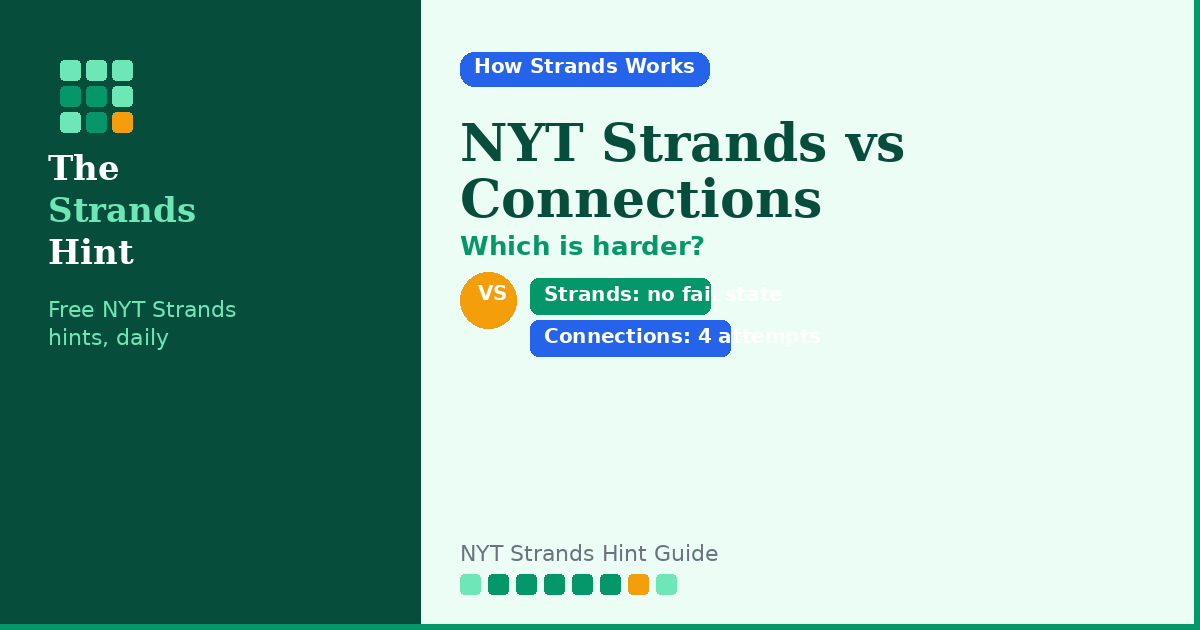
NYT Strands vs Connections — Which Is Harder?
Both NYT Strands and Connections are free daily word puzzles from The New York Times Games — and both are themed, category-based word puzzles that reset every day. On the surface they look similar: find the theme, group the words. But under the surface they’re fundamentally different games that challenge different cognitive skills. This guide breaks down every key difference and answers the question players ask most: which one is actually harder?
| About this guide:Based on direct daily play of both NYT Strands and Connections since their launches. All comparisons reflect current puzzle mechanics as of 2025. |
| Quick answer:Connections is harder in a narrow, high-pressure way: four attempts, clear fail state, tricky category overlaps that punish overconfidence. Strands is harder in a broader, more sustained way: theme decoding requires lateral thinking, the spangram can be deeply hidden, and the puzzle takes longer. Overall: Connections feels harder on bad days; Strands is harder to master. |
What Is NYT Connections?
NYT Connections is a daily word puzzle where you’re given 16 words and asked to sort them into four groups of four — each group sharing a hidden connection. The four groups are colour-coded by difficulty: yellow (easiest), green, blue, and purple (hardest). You have four attempts — if you make four wrong guesses, the puzzle ends and the answers are revealed.
Connections was created by Wyna Liu, associate puzzle editor at The New York Times, and launched in 2023. Like NYT Strands, it’s part of the free NYT Games suite alongside Wordle and the Mini Crossword.
What Is NYT Strands?
NYT Strands is a daily themed word-search puzzle played on a 6×8 letter grid. You find all the theme words by connecting adjacent letter tiles — they turn blue when correct. One special word, the spangram, spans the full grid and turns gold. You earn hints by finding non-theme words, and there is no fail state. For a complete overview, see our beginner’s guide to NYT Strands.
The Core Difference — Given Words vs Hidden Words
The most fundamental difference between the two puzzles: in Connections, the words are given to you. All 16 words sit on screen — your job is to find the connections between them. In Strands, the words are hidden inside the grid — your job is to find them first, then understand how they connect.
This single difference cascades into everything else. Connections is a categorisation and pattern-recognition puzzle. Strands is a search puzzle with a categorisation layer on top. They exercise different skills even when they feel similar.
Format Comparison — Side by Side
| Connections format:16 words given on screen — nothing hidden4 groups of 4 to identify — theme connects each group4 attempts total — wrong guess = attempt lostClear fail state — 4 wrong guesses ends the puzzleNo hints — pure deduction onlyTime to complete: 2–8 minutes for most players |
| NYT Strands format:48 letter tiles in a 6×8 grid — words hidden inside6–8 theme words + 1 spangram to findNo attempt limit — unlimited triesNo fail state — puzzle stays open until completeUnlimited earned hints — via finding non-theme wordsTime to complete: 5–20 minutes for most players |
Difficulty — A Careful Comparison
Difficulty comparison between Connections and Strands is genuinely complex because they’re hard in different ways. Here’s how they compare across every major difficulty dimension:
Pressure and fail state
Connections is harder under pressure. Four attempts is a tight constraint — one wrong guess on a hard day costs 25% of your budget. The purple group (hardest) in Connections regularly involves subtle category overlaps designed to trap players who think they’ve found a connection. The fail state is real and frustrating.
Strands has no pressure from attempts. You can try unlimited combinations. The only constraint is time — and there’s no timer. Strands’ hint system further removes pressure by providing an escape valve when you’re stuck.
Theme decoding
Connections gives you the words — the difficulty is finding which four belong together when multiple plausible groupings exist. The hardest Connections puzzles have words that appear to fit multiple categories simultaneously, trapping players who guess confidently.
Strands requires you to decode the theme before you find the words — the hint is your only guide. On hard days, the hint requires multiple lateral thinking steps. As covered in our guide to common Strands theme categories, this decoding skill takes time to develop and can completely stump players on difficult puzzles.
Time investment
Connections is faster on average: 2–8 minutes for most players on most days. Strands takes 5–20 minutes — sometimes longer on hard days. If time is your constraint, Connections is the more efficient daily puzzle.
Learning curve
Connections has a shallower learning curve. The rules are simple and the format is immediately intuitive — 16 words, find 4 groups. Most new players understand the mechanic within one or two puzzles.
Strands has a steeper learning curve. Understanding how hints work, learning to decode hint phrases, developing the spatial skill to find words in the grid, and mastering spangram-finding all take deliberate practice. But the ceiling is higher — experienced Strands players find genuine satisfaction in the mastery that Connections rarely requires.
Hint Systems — Fundamentally Different
Connections has no hint system whatsoever. Your four attempts are your only tool. There is no way to get help inside the puzzle — external hint guides are the only option.
Strands has an unlimited earned hint system built into the game. As explained in our complete hints guide, you earn hints by finding non-theme words, and there’s no cap on how many you can use. This makes Strands significantly more accessible for players who get genuinely stuck.
| Hint system comparison:Connections: No hints. 4 attempts only. External guides are the only help.NYT Strands: Unlimited earned hints. No fail state. Lightbulb icon highlights theme words. |
Which Is Harder — The Honest Answer
The honest answer depends on what kind of hard you find most challenging:
- If you find pressure and limited attempts stressful: Connections is harder. Four attempts and a real fail state create genuine stakes that Strands doesn’t have.
- If you find lateral thinking and theme decoding challenging: Strands is harder. Decoding cryptic hints and finding hidden words requires skills that Connections’ straightforward ‘group these words’ format doesn’t.
- If you find spatial reasoning difficult: Strands is harder. Finding words in a letter grid requires spatial pattern recognition that Connections doesn’t test at all.
- If you find subtle category overlap tricky: Connections is harder. Its hardest purple groups are specifically designed to create false positive connections that trap confident players.
Overall consensus among players who play both daily: Connections feels harder in the moment — the pressure of limited attempts and the sting of a wrong guess make it feel more intense. Strands is harder to master — the depth of skill it rewards (lateral thinking, theme recognition, spangram hunting, spatial search) has a higher ceiling. Both are worth playing — they complement each other well as part of a daily NYT Games routine.
Should You Play Both?
Yes — and most serious NYT Games players do. Connections and Strands together take 10–25 minutes, fit naturally into a morning routine, and develop different cognitive skills. Adding Wordle to the mix brings a third skill (deductive word guessing) and the complete suite is under 30 minutes for most players.
All three are free at nytimes.com/games. No subscription required.
Frequently Asked Questions
Is NYT Strands harder than Connections?
It depends on what kind of difficulty you find challenging. Connections is harder under pressure — four attempts, a real fail state, and subtle category traps. Strands is harder to master — it requires lateral thinking to decode hints, spatial skill to find words, and strategic spangram-hunting. Most players find Connections more stressful; Strands more mentally demanding.
What is the difference between NYT Strands and Connections?
In Connections, 16 words are given to you and you sort them into four groups of four. In Strands, 6–8 theme words plus a spangram are hidden in a 6×8 letter grid and you have to find them. Connections is a categorisation puzzle; Strands is a search puzzle with a categorisation layer. Both are themed and daily, but they test different skills.
Does Connections have hints?
No. Connections has no built-in hint system. You have four attempts and nothing else. If you want help, you need an external hint guide. NYT Strands, by contrast, has an unlimited earned hint system built into the game.
Which NYT puzzle is better for beginners?
Connections has a shallower learning curve — the rules are simpler and the format is immediately intuitive. Strands has more mechanics to learn (hint system, spangram, grid navigation) but no fail state makes it more forgiving. Most beginners find Connections easier to start with; Strands becomes more rewarding with practice.
Can you fail NYT Strands like you can fail Connections?
No. Strands has no fail state. You can take as long as you want, try unlimited combinations, and use as many earned hints as you need. Connections ends after four wrong guesses. This makes Strands significantly less punishing on hard days.
Are NYT Strands and Connections both free?
Yes. Both NYT Strands and Connections are completely free to play at nytimes.com/games. No New York Times subscription required for either puzzle.